Shockwave therapy – information for podiatry patients
Shockwave therapy – information for podiatry patients
This information is for patients who have been invited for shockwave therapy at our Podiatry department at Horton Park Medical Centre in Bradford or Skipton General Hospital.
It includes details of what to expect when you come for treatment. If you have any questions or concerns not covered by the information below, please speak to your podiatrist or phone 01274 221165 Monday to Friday 8.30am – 4.30pm.
What is shockwave therapy?
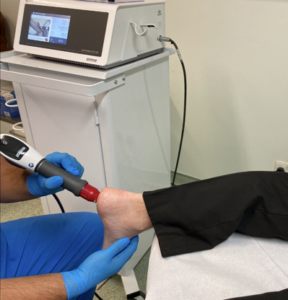 Shockwave therapy is a non-invasive surgical treatment where audible, low energy sound waves are passed through the skin to the injured part of the body using a special device.
The shockwaves are mechanical, not electric, and are used to increase blood flow to the injured area to speed up the body’s healing process and break down scar tissue. Usually a course of 4-6 treatments is required, one week apart.
Why should I have shockwave therapy?
If you have been experiencing chronic pain from plantar fasciitis and Achilles insertional and midportion tendinopathy and have not responded well enough to other non-surgical treatments, such as first line podiatry, orthotics/insoles, physiotherapy, exercises/stretches, rest, ice therapy or painkillers, you may be offered shockwave therapy for relief from pain and other symptoms.
What are the risks and side effects?
The National Institute for Health and Care Excellence (NICE) has deemed this procedure to be safe.
You can expect some pain or discomfort during the treatment, but most people are able to tolerate this without any problem. After the treatment, you may experience redness, bruising, swelling and numbness to the area. These side effects should resolve within the week before your next treatment. There is a very small risk of tendon or ligament rupture and damage to the soft tissue.
You will be monitored before and after treatment to discover how successful the outcome is. There is a small chance that after treatment the condition may get worse, but your podiatrist will discuss the benefits and risks with you in more detail when you are offered the procedure.
Who should not have shockwave therapy?
You must not have this therapy if you:
- are pregnant
- are unable to understand what this treatment is
- have previously had an abnormal reaction to shockwave therapy
- are taking antiplatelet medication such as Clopidogrel, or anticoagulant medication such as Marcumar, Warfarin or Rivaroxaban
- are taking certain antibiotics – fluoroquinolones, tetracyclines, doxycycline or macrolides – as they increase the risk of tendon rupture, please wait until the course of antibiotic treatment has finished
- have a history of tendon or ligament rupture
- have a coagulation/blood clotting disorder
- have thrombosis, osteoporosis or an infected wound
- have a tumour disease or are being treated for carcinoma
- use a pacemaker, or have acute cardiac arrhythmias or heart failure
- have untreated low or high blood pressure, poorly controlled diabetes or epilepsy
- have taken steroids or had a steroid injection or cortisone therapy in the previous 12 weeks before the first shockwave treatment.
Your podiatrist will discuss the above with you when you are offered treatment.
How can I prepare for treatment?
- Please make sure you are available for the full course of 4-6 treatments, as missing dates may affect the success/outcome of the treatment and treatment may be withdrawn.
- Please attend your appointment wearing loose fitting comfortable trousers, shorts or a skirt, as well as footwear and hosiery which is easy to remove to calf level.
- Do not take non-steroidal anti-inflammatory medication such as Ibuprofen or Naproxen, Aspirin, or medication that contains Aspirin (for example, flu remedies) two weeks before your first procedure, throughout your treatment and up to six weeks after treatment. However, if you have been prescribed Aspirin 75mg by a doctor for a specific medical condition you should continue take this.
- Do not undertake strenuous, pain-provoking activity or high impact exercise during the course of treatment and six weeks after treatment.
- You can eat and drink normally before and after your treatment.
Asking for your consent
We want to involve you in decisions about your care and treatment. If you decide to go ahead with shockwave therapy, you will be asked to sign a consent form. This states that you agree to have the treatment and you understand what it involves. If you would like more information about our consent process, please speak to a member of staff caring for you.
Who will carry out the procedure?
Your treatment will be carried out by a podiatrist or a podiatry assistant who has undertaken specialist training in the procedure.
What happens during the treatment?
You will be asked to lie on the couch/plinth on your front and on your back – please inform the clinician if this will be an issue for you. The clinician will put some ultrasound gel on the painful area. The hand piece of the therapy machine will then be placed on the gel to deliver pulses of compressed air through the gel.
You will be asked how much pain you are experiencing during the treatment, and we will attempt to adjust the treatment to help manage this. The pain usually stops at the end of your procedure.
Treatment takes approximately 30 minutes for one foot and up to 45 minutes for both feet.
What happens after treatment?
After treatment you will be able to get up and walk straight away. If you do experience discomfort following treatment you can take over-the-counter painkillers (such as Paracetamol), but avoid anti-inflammatory medication (such as Ibuprofen or medication containing Aspirin – excluding prescribed Aspirin 75mg) and ice therapy, for up to six weeks after treatment as these can interfere with the body’s healing process.
What do I need to do after I go home?
You will be able to return to your usual activities straight away and can return to work immediately. We advise you not to undertake any strenuous, pain-provoking activity or high impact exercise during the treatment period and for at least six weeks after your last treatment or the condition may get worse. It is advised that you wait for eight weeks before you gradually build up your activities. If you experience a sudden onset of pain to the area or any loss of function, please contact your GP or go to your nearest emergency department (A&E).
Will I have a follow-up appointment?
Yes, you will have a telephone appointment approximately four weeks after your final treatment.
More information about shockwave therapy
The National Institute for Health and Care Excellence (NICE) has produced recommendations for patients having extracorporeal (outside of the body) shockwave therapy.
Language and accessible support services
If you need an interpreter or information about your care in a different language or format, please call 01274 221165.
NHS 111 offers medical help and advice from fully trained advisers, supported by experienced nurses and paramedics over the phone 24 hours a day – just phone 111.
NHS Choices provides online information and guidance on all aspects of health and healthcare, to help you make choices about your health. www.nhs.uk
Compliments comments, concerns or complaints
To give your feedback or raise a concern or complaint, please contact our Patient Advice and Complaints department on 01274251440 or advice.complaints@bdct.nhs.uk