Booklet five: panic attacks
-
Big changes in your life can cause feelings of anxiety or panic that you may not have experienced before. They may feel very frightening and you may start to wonder whether you’re ill. Evidence shows that learning about what happens to your body when you’re anxious can help you cope with the anxious feelings. It’s easy to feel very concerned about feelings such as dizziness, tingling in the limbs, a racing heart and breathlessness; however, these feelings are simply brought on by anxiety and by knowing this you can learn to be less frightened by them when they happen.
Commonly held fears associated with panicky feelings and changed body symptoms:
- I’m going to faint
- I’m having a heart attack
- I’m choking
- I’m suffocating
- I’m going to humiliate myself I’ll collapse and no-one will help
- I’m dying
- I’m going to lose control of my bowels
No-one has ever died of a panic attack. Though the physical sensations of panic can be terrifying, these symptoms are all the bodies natural responses to threat. Panic cannot harm you.
Too much caffeine, low blood sugar, pregnancy, thyroid problems and some combinations of medication can lead to similar bodily symptoms as panic attacks.
Your GP could help you identify if there is a physical problem or if you’re having panic attacks.
Some people have panic attacks every day. Others only occasionally. Panic attacks are very common.
-
The body has a natural ‘fight or flight’ response which allows it to protect itself from anything it perceives as threatening. What happens to the body during this response is a release of adrenaline which makes the body ready for action.
- The heart beats much faster in order to move blood round the body as quickly as possible.
- Body systems that aren’t essential for fighting or running away slow down which is why your stomach becomes uncomfortable.
- Breathing speeds up in order to increase the amount of oxygen available to the muscles.
When people become over-tired, stressed or overwhelmed this response can become exaggerated. For example if you have the thought ‘I’m going to die’ your anxiety will increase and as it does those frightening symptoms become stronger. You then may want to avoid things such as leaving the house or bathing the baby. When feelings of panic come unexpectedly that can be frightening.
The cycle below shows how thoughts, feelings and behaviours can increase panic.
An example of what happens when panic starts.
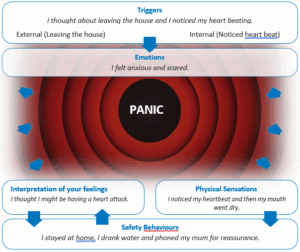
As the panic starts, you notice the emotions and the physical feelings. Its normal to wants to stops these feelings and so it makes sense that you would start to avoid these feelings at all costs.
By trying to avoid them you can make panic attacks worse (see booklet 6 on avoidance). it’s helpful to accept that the feelings are unpleasant and deal with them while they’re happening by reminding yourself that you can cope.
E.g. you might say to yourself: ‘being anxious is normal, it’s a sign I’m on the alert.’
Or ‘the bodily symptoms are dreadful but I know it’s only the adrenaline release, other people cannot see how I’m feeling’ Remember, these feelings cannot harm you, keep breathing, these feelings will pass and you’ll be OK.
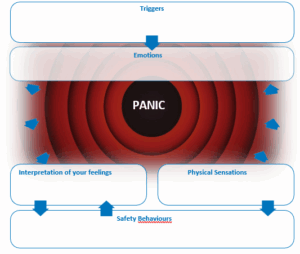
An example of what happens when panic starts.
-
Panic attacks cannot harm you
- By avoiding doing things in case you have a panic attack you’re telling yourself that you’ll panic and are more likely to do so.
- The more you do the things you panic about the less you’ll panic.
- When you’re having a panic attack you could say “This is a panic attack, it will not harm me, it feels unpleasant but it will pass”.
-
Breathing
If you’re feeling stressed and anxious it’s likely you’ll be breathing with short, sharp breaths that only use part of your lungs. By learning to breathe more deeply your breathing will start to slow down, bringing a feeling of calmness and control.
First ask yourself how stressed /anxious/angry you feel. Rate it from 0-10 with 0 as calm.
Hold your breath for a count of 3. This disrupts your unhelpful breathing pattern. Try to breathe in through your nose. Imagine you’ve a balloon in your stomach that you need to fill with the air. You don’t want your chest to rise higher (this indicates more shallow breathing). You want your stomach to rise as this shows you’re doing deep abdominal breathing.
Place one hand on your chest and one hand on your stomach – you should see the hand on your stomach rising most. Now breathe in for a count of 3, hold the breath for a count of 2 then breathe out through your nose or mouth for a count of 4. Repeat.
After repeating 3 times rate how you feel again, between 0-10. Are you calmer? If not repeat again and re-rate, continue to do so until you feel a positive effect.
If you’re beginning to feel better decide if you need to repeat again for more benefit.
It’s possible that slowing your breathing will make you feel dizzy. This is simply a result of you getting more oxygen than you had before.
Ultimately learning to slow your breathing will enable you to feel physically and mentally more calm and relaxed.
-
Stop focusing on your symptoms – distract yourself. Focus on something else, other people, a song, count cars. Distract yourself for 3 minutes. you’ll stop thinking thoughts that encourage the panic attack.
Challenge your thoughts: Remind yourself that this is a panic attack. It may be unpleasant but it cannot hurt you. The symptoms are normal responses to stress and the release of adrenalin. It will pass and you’re going to be OK.
Challenge your behaviour – DO NOT AVOID situations or rely on safety behaviours. This can lead to avoiding more and more things and will not stop panic attacks. However, facing situations is an effective way of making panic attacks occur less frequently and become more manageable.
-
- Panic attacks cannot harm you. The more you do the things that you panic about the LESS you’ll panic.
- By avoiding doing the things in case you panic you’re telling yourself that you’ll panic and so are more likely to do so.
- Panic attack symptoms are not an indication that you’re going to have a heart attack, stroke, pass out, have a brain tumour. They’re NORMAL reactions to the release of adrenalin.
- Relax and tell yourself “this is a panic attack. It cannot harm me. It may feel unpleasant but it will pass”.
- Now read the booklet in this series about Overcoming Avoidance, booklet 6.