Continence pads provision
Continence pads provision
Why we are proposing changes
Bradford District Care Trust is commissioned to provide continence pads for adults in Bradford District and Craven who have had a specialist assessment of their needs. The cost of providing these pads has risen greatly over the last five years. This is due to:
- an increase in demand
- the complexity of people’s needs
- an increase in product costs, and
- an increase in delivery costs.
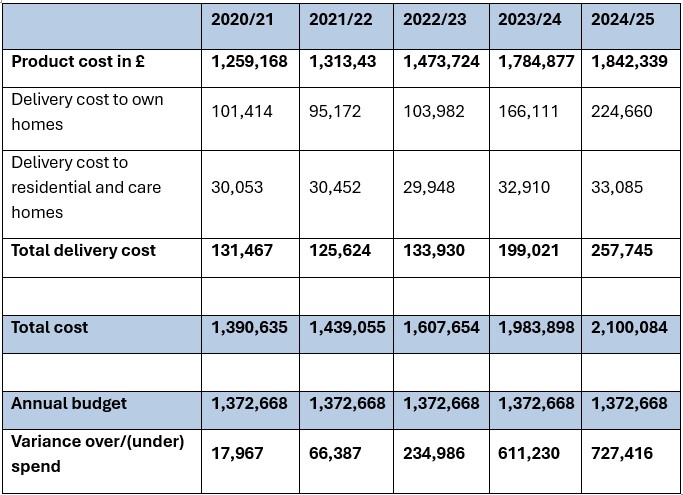
You’ll see for example from the table below, that the costs of delivering pads to people’s individual homes has doubled since 2020. In the last year, the total spend on continence pads provision was approximately £2.1 million.
Whilst costs have increased markedly, the c£1.3 million budget provided to Bradford District Care Trust to fund continence pads has not changed, leading to an overspend each year for five years, and in the last year this was over £720,000.
As there is no additional budget available, the Trust is proposing some changes which will enable us to reduce spending whilst ensuring we continue to support our patients, most especially those with the greatest needs.
If any changes happen, everyone who gets continence pads will get a letter explaining what the changes mean for them.
Continence product costs v budget
The table below shows the rise in costs against our static budget and the over spend:
Our proposed changes
We propose three key changes:
Delivery cycles
Currently, most continence pads are delivered every 12 weeks, we propose extending the delivery cycle to every 16 weeks, which will enable us to reduce delivery costs without impacting on the products provided.
Provision of lower absorbency pads
These pads, such as TENA Comfort Mini Super, Comfort Mini Plus, Comfort Mini Extra and TENA Men are cheaper to purchase than higher absorbency products. Branded and own brand and are readily available online and in a variety of stores including all major supermarkets.
A significant portion of the general population currently purchase lower absorbency products independently to meet their needs, so we propose stopping the provision of these pads. If service users can purchase these themselves, our budget can be focused on supporting individuals whose incontinence needs are greater.
Numbers of pants and pads provided
We aim to be fair to all our service users and to ensure each person still receives the majority of pads they need free of charge. However, we must make savings. To reduce the financial impact on an even basis we propose reducing the numbers of pads supplied:
- pull up pants – anyone in receipt of three pull up pads per 24 hours will be reduced to two pull up pads per 24 hours
- continence pads – anyone in receipt of four continence pads per 24 hours, will be reduced to three pads per 24 hours.
Will will assess each person’s individual needs when referred to our service and recommend the amount of continence pads required, however, service users will be expected to purchase any additional pads they need over those we are able to provide free of charge.
Next steps
Gathering feedback
We do not want to introduce changes without making people who use our continence service of what we propose and offering those service users and others the opportunity to share their thoughts and views. We are currently gathering feedback via an online questionnaire, paper questionnaire and online and in-person events – see details.
Once those activities conclude and if any changes are made, anyone who receives continence pads or pants from us will be written to individually to explain what the change will mean for them.
Working together
In addition to the changes proposed above, Bradford District Care Trust will continue to work with wider health services and independent care providers (home care and care homes) to
- explore opportunities to reduce future demand for continence products through improved prevention and lifestyle changes, and
- support the most efficient use of continence pads provided free of charge by our Trust.
Supporting people impacted by the proposed changes
Although we believe the proposed changes are necessary to enable our Trust to live within its financial means, we recognise the impact they may have on some service users, especially those who will be required to purchase some products.
In response to this, we are working to ensure that additional support is available for those affected. This will include signposting service users to Health and Wellbeing hubs for benefits advice.